

How a Clean Home Quietly Decreases Anxiety

About this post
A clean home isn't just tidier—it measurably lowers stress. Drawing on cortisol research, clutter-attention studies, and recent wellbeing surveys, this post explains the psychology behind why decluttering and cleaning quiet anxiety, and why "good enough" clean is enough to feel the benefit.
Posted by
Meg from UrbanTags
- Wellbeing
- City life
- Mental health
Book a treatment at home
Share
There's a reason you exhale when you walk into a tidy room — and it isn't just in your head. It's in your cortisol.
Psychologists have spent the better part of two decades studying what happens in our bodies and brains when our homes are cluttered versus calm, and the findings are remarkably consistent: the state of your home is not a cosmetic issue. It's a nervous-system issue.
Your brain can't ignore clutter, even when you try to
Every object in your field of vision competes for your brain's limited visual processing capacity. A widely cited Princeton Neuroscience Institute study found that multiple stimuli within view compete for neural representation in the visual cortex, and that clearing physical clutter allows the brain to focus more effectively on a single task. In plain terms: a messy kitchen counter is quietly taxing your attention even when you think you're ignoring it.
This lines up with research from the Journal of Environmental Psychology, which found that clutter doesn't just chip away at psychological wellbeing — it also erodes what researchers call "psychological home," the felt sense of belonging and safety a living space is supposed to provide.
The clutter–cortisol connection is measurable, not anecdotal
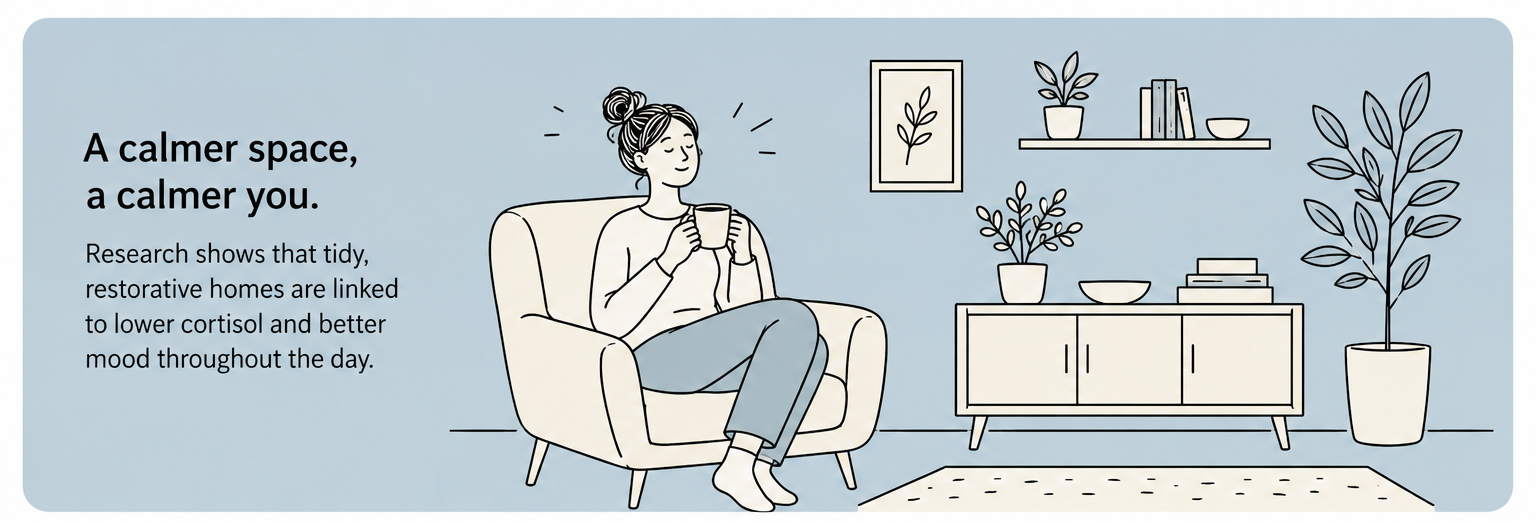
Perhaps the most striking evidence comes from UCLA's Center on Everyday Lives of Families, where psychologist Darby Saxbe and colleagues followed dozens of dual-income couples and tracked their cortisol — the body's primary stress hormone — across the day. Women who described their homes as cluttered or full of unfinished projects showed measurably higher cortisol levels that stayed elevated throughout the day, rather than following the normal pattern of tapering off toward evening. Women who described their homes as restful and restorative showed the opposite: flatter, healthier cortisol curves and lower depressed mood over the course of the day.
Saxbe's interpretation is that cleaning and order give people a rare sense of mastery over their environment — in a world full of things we can't control, our living space is one of the few things we can. That sense of controllability is directly tied to reduced anxiety in the psychological literature on stress.
The numbers back it up
You don't have to take psychology's word for it — people report the effect themselves. In a 2024 survey by the American Cleaning Institute, 60% of respondents said a clean home reduced their stress and anxiety, alongside gains in mood (66%) and a sense of accomplishment (70%). A separate 1,000-person survey found that just over three-quarters of adults feel less stressed after cleaning their home, and that the kitchen — often the most chaotic room by mid-week — is the single most "therapeutic" room to tidy, with 77.7% reporting a stress reduction after cleaning it specifically.
There's also a physiological angle that's easy to overlook: light physical activity. Researchers at Indiana University found an association between tidier homes and higher levels of physical activity, likely because the actions of cleaning — vacuuming, dusting, moving through rooms — function as low-intensity exercise, which has its own well-documented anxiety-reducing effects.
Why clutter feels like an unfinished task your brain won't let go of
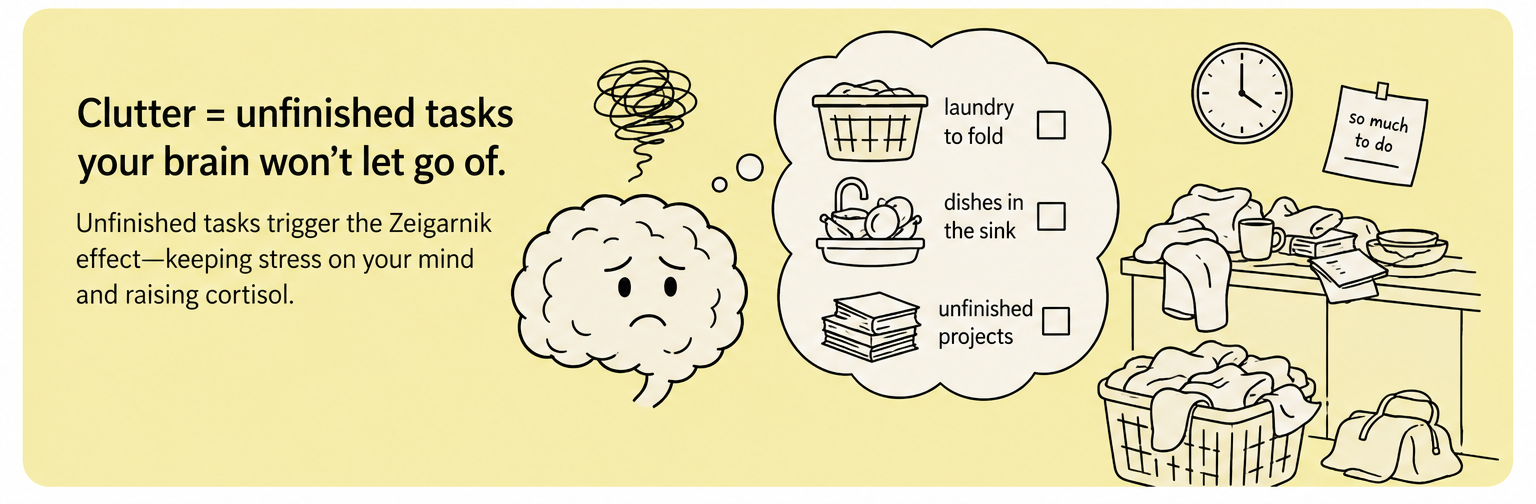
There's a cognitive reason a messy home feels so mentally loud: unfinished tasks create what psychologists call the Zeigarnik effect — our brains hold onto incomplete tasks more persistently than completed ones. A pile of laundry or a sink of dishes isn't just visually present; it's a standing, unresolved item your brain keeps quietly re-surfacing. This is also why research in Current Psychology has linked clutter to higher rates of task procrastination — an overwhelming space makes it harder to start anything, including the cleaning itself.
Where this leaves you
None of this means your home needs to be showroom-perfect. The research is about restoration, not perfection — a "good enough" clean, done consistently, appears to do most of the psychological heavy lifting. But it does mean that a chronically overwhelmed, cluttered home isn't a minor inconvenience sitting in the background of your life. It's an ongoing, low-grade input into your stress physiology.
If your to-do list keeps pushing cleaning to the bottom, it might be worth reframing it: a clean home isn't just about appearances. It's one of the more evidence-backed, low-effort tools available for taking your nervous system down a notch.
Sources
Saxbe, D.E. & Repetti, R. (2010). No place like home: home tours correlate with daily patterns of mood and cortisol. Personality and Social Psychology Bulletin.
American Cleaning Institute / Wakefield Research (2024). National Cleaning Week survey.
Homeaglow (2024). U.S. survey on cleaning and mental health, 1,000 respondents.
Princeton Neuroscience Institute (2011). Research on visual clutter and attentional load.
Journal of Environmental Psychology. Research on clutter, wellbeing, and "psychological home."
Indiana University research on household tidiness and physical activity.
Roster, C. et al. (2016), UCLA. Clutter and cortisol research.
Discover the easy way to book cleaning services, as well as at-home clinic and spa treatments with the Urban app.
Book on-demand servicesBook a standard or deep clean, from 7am to 11pm, 7 days a week.
Book a home clean