

How Often Should You Actually Clean Each Room? A Room-by-Room Guide

About this post
A practical, room-by-room breakdown of realistic cleaning frequencies—kitchen, bathroom, bedroom, living room and home office—based on how quickly each space actually gets dirty. Replaces vague "clean when it needs it" advice with a concrete daily/weekly/monthly schedule, plus the honest case for consistency over ambition.
Posted by
Meg from UrbanTags
- Wellbeing
- City life
- Mental health
Book a treatment at home
Share

There's no shortage of cleaning schedules online. The problem is most of them are arbitrary — weekly because weekly sounds reasonable, monthly because monthly sounds manageable. What's rarely explained is the underlying biology: how quickly bacteria multiply, how allergen loads accumulate, and at what point neglect starts affecting your health rather than just your conscience.
Here's what the evidence actually says, room by room.
The kitchen — the most contaminated room in your home, and not for the reasons you think
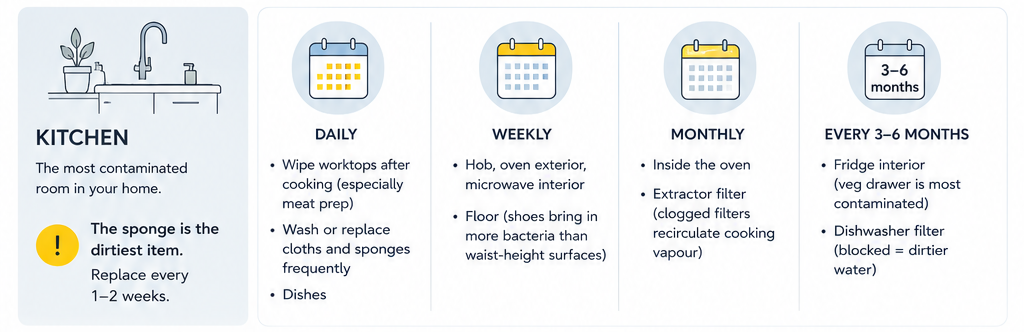
Most people assume the bathroom is the dirtiest room. Microbiologists disagree. The kitchen is consistently found to harbour higher bacterial loads — particularly around the sink and worktops — because it combines organic matter (food residue), warmth, and moisture: the ideal conditions for microbial growth.
The most contaminated item in the average kitchen isn't the bin. It's the sponge.
A 2017 study published in Scientific Reports found 362 distinct species of bacteria in used kitchen sponges, with bacterial density reaching up to 7.9 million bacteria per cubic centimetre — comparable to faecal contamination levels. Crucially, cleaning a sponge in the microwave or boiling it doesn't resolve the issue; it reduces overall load but allows resistant strains to proliferate. Sponges should be replaced every one to two weeks, not sanitised and reused indefinitely.
On worktops: surfaces used for raw meat preparation can harbour Salmonella, Campylobacter, and E. coli O157 — all capable of causing serious illness — for up to four hours without cleaning. Cross-contamination from worktops to hands to faces accounts for a significant proportion of domestic foodborne illness cases.
What this means in practice:
Daily: wipe worktops after cooking (especially meat prep), wash or replace cloths and sponges frequently. Dishes don't need elaboration.
Weekly: the hob, oven exterior, microwave interior, and floor. The floor because you walk through the kitchen in the same shoes you've worn outside — studies show domestic floors carry significantly higher bacterial loads than surfaces at waist height, which matters if you have young children.
Monthly: inside the oven, extractor filter. Grease accumulation in extractors is not just a fire risk — a clogged filter recirculates cooking vapour into the room air.
Every 3–6 months: fridge interior (the vegetable drawer is typically the most contaminated compartment), dishwasher filter (a blocked dishwasher filter means your crockery is being "cleaned" in progressively dirtier water).
The bathroom — it looks clean well before it is
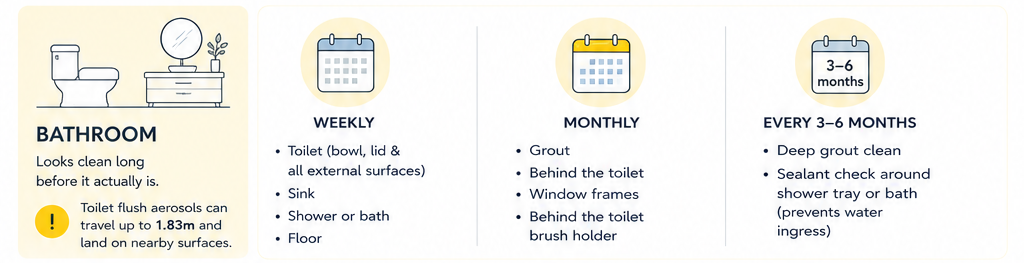
Bathroom surfaces can look presentable while harbouring significant bacterial contamination. This is a problem, because visual cleanliness is the primary trigger most people use to decide whether the bathroom needs attention.
The toilet flush is the key mechanism to understand. Each flush generates an aerosol plume — studies have shown that microorganisms including faecal coliforms can travel up to 1.83 metres from the bowl during flushing, and settle on all nearby surfaces including the sink, toothbrush holders, and towels within that radius. Keeping the lid closed before flushing reduces — but doesn't eliminate — this contamination.
The toilet itself should be cleaned at least weekly, regardless of how it looks. Faecal coliforms were detected on bathroom surfaces in 8 out of 20 homes studied in routine microbiological surveys — not because those homes were dirty by any visible standard, but because the biology of a bathroom makes contamination the default, not the exception.
What this means in practice:
Weekly: toilet (bowl and external surfaces, lid included), sink, shower or bath, floor. The floor matters in a bathroom for the same reason it matters in a kitchen — it's a direct transfer surface.
Monthly: grout, behind the toilet, window frames, the area behind the toilet brush holder. Grout is porous and retains moisture, making it a persistent site for mould growth even when it doesn't look visibly affected.
Every 3–6 months: a proper grout clean, sealant check around the shower tray or bath. Failed sealant allows water ingress into the wall structure — one of the more expensive household problems to fix once established.
The bedroom — allergens, not dirt, are the issue
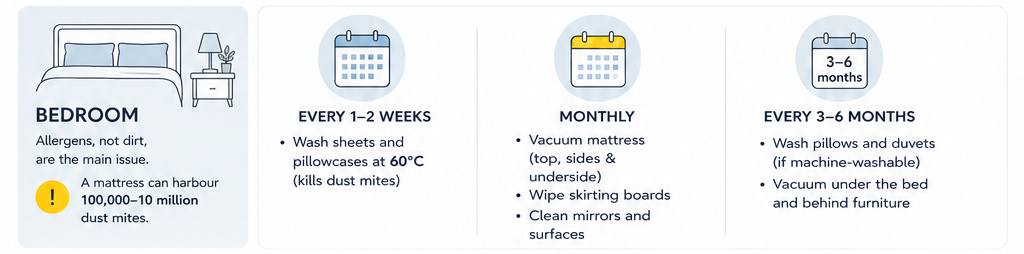
The bedroom presents a different problem from the kitchen and bathroom. The primary concern isn't bacterial contamination — it's allergen accumulation, particularly dust mites and their metabolic waste products.
Dust mites are eight-legged arachnids, around 0.3mm in length, invisible without magnification. They consume dead skin cells — of which a human sheds roughly 1.5 grams per day, the majority of it in the bedroom. A single mattress can harbour between 100,000 and 10 million dust mites depending on humidity and cleaning frequency. The mites themselves don't bite or transmit disease. Their faecal droppings, however, are among the most potent indoor allergens identified, linked to worsened asthma, allergic rhinitis, and disrupted sleep architecture.
The washing temperature matters. A 2019 study found that after one week, unwashed pillowcases harboured bacterial loads exceeding those found on toilet seats. By week four, the colony-forming unit count — a measure of viable microorganism density — had more than doubled from the week-one level. Cold water washing reduces allergen load but does not kill mites. 60°C is the minimum effective temperature.
What this means in practice:
Every 1–2 weeks: wash sheets and pillowcases at 60°C. Most people wash closer to monthly; most allergy specialists recommend fortnightly at minimum.
Monthly: vacuum the mattress (the top surface only is insufficient — the sides and, where possible, the underside matter), wipe down skirting boards, clean mirrors and surfaces.
Every 3–6 months: wash pillows and duvets (most are machine-washable and labelled accordingly), vacuum under the bed and behind furniture. Dust accumulates behind furniture at a similar rate to open surfaces but is rarely addressed.
The living room — it depends almost entirely on use
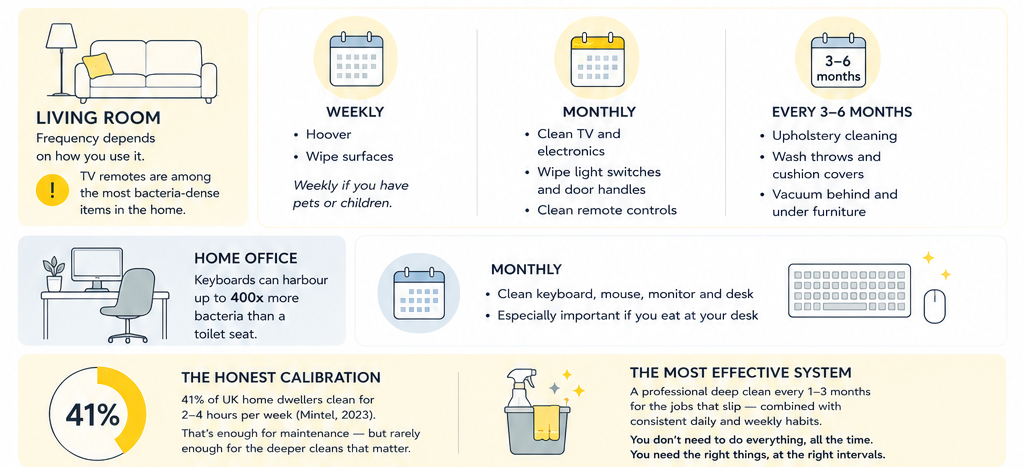
The living room's cleaning frequency is more variable than other rooms because it depends on whether it's a genuine living space or a rarely-used formal one, whether you have pets, children, or a habit of eating on the sofa.
The TV remote is worth singling out. A University of Arizona study found TV remotes among the most bacteria-dense surfaces in a typical home — handled frequently by multiple people, rarely cleaned, and often touched after eating or by someone who's unwell. Wiping it down monthly with an antibacterial cloth is a 30-second task with disproportionate hygiene impact.
Pet owners should double the vacuuming frequency compared to the below. Pet dander is a persistent allergen, and pet hair acts as a carrier for outdoor allergens brought in on paws and fur.
What this means in practice:
Weekly: hoover, wipe surfaces. If you have pets or children, weekly is non-negotiable — bi-weekly if you genuinely don't use the room much.
Monthly: TV and electronics (dust on electronics isn't just aesthetic — it impairs heat dissipation and shortens device lifespan), light switches and door handles (high-touch surfaces, rarely cleaned, significant cross-contamination risk), remote controls.
Every 3–6 months: upholstery cleaning, washing throws and cushion covers, vacuuming behind and under furniture.
The home office — covered separately in detail, but the headline figure
Keyboards harbour up to 400 times more bacteria than a toilet seat, according to consumer testing. If you're eating at your desk — and WFH culture makes this common — food residue creates breeding conditions for Staphylococcus aureus and enteric bacteria. Monthly keyboard and monitor cleaning is hygiene maintenance, not excessive caution.
The honest calibration
The frequencies above represent what the evidence recommends, not what most people do. The gap between the two is significant. In a 2023 Mintel survey, 41% of UK home dwellers reported cleaning for between two and four hours a week total — which, spread across all rooms, allows for maintenance but rarely for the deeper periodic cleans that actually address allergen and bacterial accumulation.
The practical implication: the most effective system is one you can maintain. A professional deep clean every one to three months — handling the periodic tasks that slip most reliably — combined with consistent daily and weekly habits outperforms an ambitious schedule that exists on paper and breaks down in practice. You don't need to do everything, all the time. You need the right things done at the intervals that actually matter biologically.
Sources: Rintala et al. (2017), Scientific Reports — kitchen sponge bacteria; Abney et al. (2021), Journal of Applied Microbiology — toilet aerosol plumes; Applied and Environmental Microbiology (2019) — bedding bacterial load; University of Arizona keyboard contamination studies; Asthma and Allergy Foundation of America — dust mite guidance; Mintel UK Cleaning in and Around the Home Market Report 2023.
A thorough, dependable clean with a trusted pro — so your home is always ready when you need it to be. Book it weekly, fortnightly or monthly - and save 11% vs a one-off domestic clean.
Book a regular cleanBook a standard or deep clean, from 7am to 11pm, 7 days a week.
Book a home clean