

The End-of-Summer Reset: Why a Deep Clean Is Good for Your Head, Not Just Your Home

About this post
A seasonal case for cleaning as a genuine mental reset, not just tidying. Covers why transition points like end-of-summer are the natural moment to reset your space, the cortisol research linking clutter to stress, and how to treat a deep clean as a purposeful ritual rather than another chore—plus when it's worth bringing in help to make sure it actually happens.
Posted by
Meg from UrbanTags
- Wellbeing
- City life
- Mental health
Book a treatment at home
Share
Every September, something shifts. Not just the light — though that's real and measurable — but something in your internal rhythm. You start wanting to reorganise, clear things out, close the windows and make the flat feel different. Most people attribute this to routine kicking back in, or some vague nesting instinct. The science suggests it runs deeper.
What's actually happening in your brain when the season turns
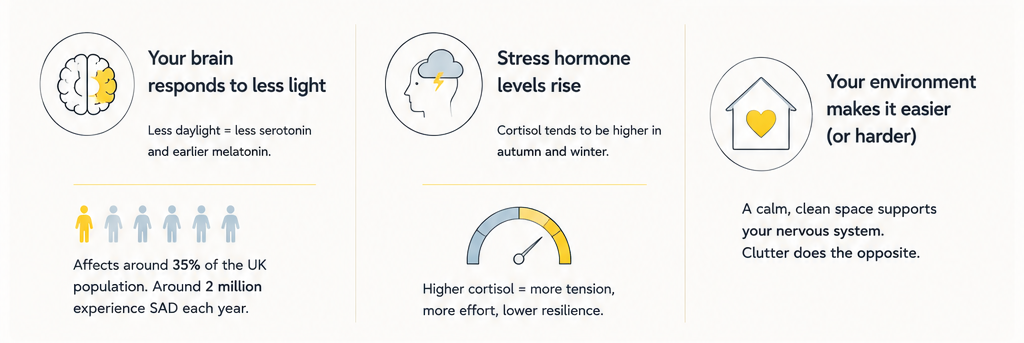
As daylight hours drop from late summer into autumn, two things happen simultaneously. Your brain produces less serotonin — the neurotransmitter most associated with mood stability — and begins producing melatonin earlier in the evening. This isn't a mood quirk; it's a biological response to reduced light exposure that affects roughly 35% of the UK population to some degree, with an estimated 2 million people experiencing clinically significant Seasonal Affective Disorder each year, according to the NHS.
Even if you're nowhere near clinical SAD territory, you're likely not immune. Research published in Psychiatric Times found that seasonal variations in cortisol — the body's primary stress hormone — track closely with light exposure. Cortisol levels tend to be higher through autumn and winter, contributing to what many people describe as a background sense of low-level tension: the feeling that everything requires slightly more effort.
The relevant question for your home: does your environment make this easier or harder to manage?
The cortisol-clutter connection, properly understood
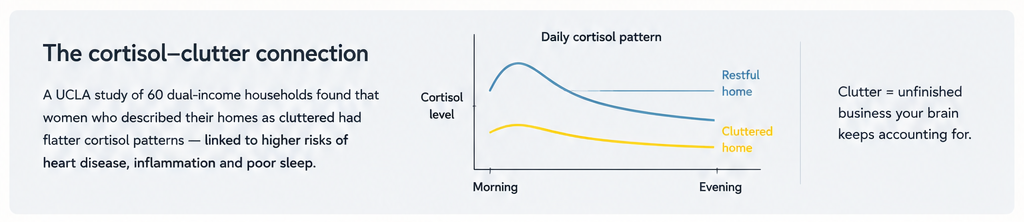
In 2010, researchers Darby Saxbe and Rena Repetti at UCLA published findings from a study of 60 dual-income households. Participants were asked to describe their homes in their own words; over the following three weekdays, saliva samples tracked their cortisol patterns. The result was unambiguous: women who described their homes as cluttered or unfinished showed flatter diurnal cortisol slopes — a pattern consistently associated with adverse health outcomes, including elevated risk of cardiovascular disease, inflammation, and disrupted sleep. Women who described their homes as restful showed steeper, healthier cortisol slopes.
The finding wasn't about cleanliness in any aesthetic sense. It was about the psychological weight of an environment that registers as unresolved — as a list of things that haven't been dealt with. Clutter, in this context, is unfinished business your nervous system keeps accounting for, whether or not you're consciously thinking about it.
At the turn of a season, this weight compounds. Summer accumulates in specific, physical ways: windows grimy from months of open ventilation, soft furnishings holding dust from months of airing, corners that got low-priority during the longer, more social evenings. Autumn arrives and you're already managing a neurological recalibration. Your environment can help absorb that, or amplify it.
Why transitions are the moment to act — not the New Year
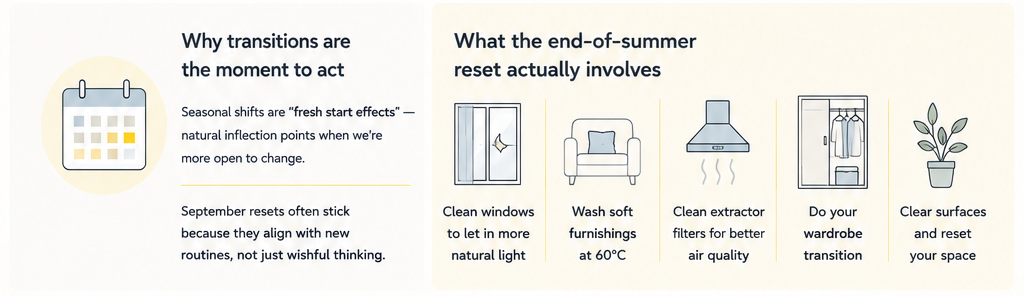
There's a reason January resolutions rarely stick but September re-sets often do: transitions are genuine inflection points. Psychologists call them "fresh start effects" — moments where people naturally reassess, update their identity a little, and are more open to behaviour change. A 2014 study in Management Science by Hengchen Dai, Katherine Milkman, and Jason Riis found that temporal landmarks (new weeks, new months, seasonal transitions) significantly increase the likelihood that people will pursue fresh-start goals.
The shift from summer to autumn is one of the most potent of these. You're already updating routines: earlier evenings, different food, changing social pace. An environment that reflects that change lands differently than one that's out of sync with the chapter you're in.
What the end-of-summer reset actually involves
This isn't a generic spring clean. The specific things that accumulate over summer — and that make autumn feel heavier — are predictable:
Windows and natural light. Autumn daylight is already diminished; letting it in matters more. Summer dust, pollen, and oxidation on glass can reduce light transmission by 20–30%. The argument for a thorough window clean is, at this point of year, a mental health one.
Soft furnishings. Curtains, throws, cushion covers, and upholstery absorb the dust, pet dander, and humidity of summer months. These are also havens for dust mites — arachnids invisible to the naked eye whose faecal droppings are potent allergens, linked to worsened asthma and disrupted sleep. A single mattress can harbour 100,000 to 10 million dust mites depending on conditions. The seasonal transition is the moment to wash soft furnishings at 60°C (the minimum temperature that kills mites, not just reduces allergen load) before you start spending more time inside.
The extractor fan and kitchen ventilation. Summer cooking — windows open, more frequent use — leaves grease accumulation in extractor filters that compounds odour and air quality as ventilation habits change in autumn. Kitchen air quality affects sleep quality more than most people account for.
Wardrobe transitions. Beyond the obvious clothes swap: the process of rotating a wardrobe typically exposes what's accumulated in corners, under beds, and on high shelves. That's not a byproduct of the task — it's the useful part.
Making it a ritual rather than a chore
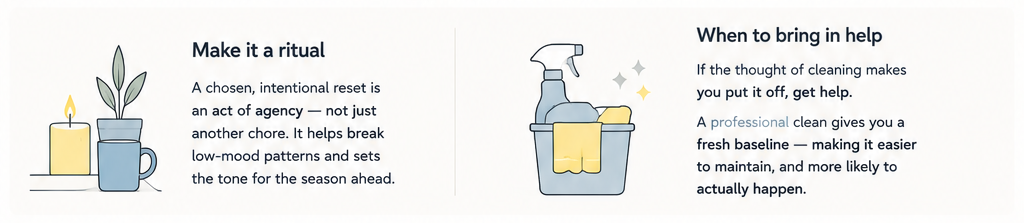
The framing isn't trivial. Research on behavioural activation — the psychological approach used in CBT for depression — shows that small, purposeful actions in your immediate environment can break low-mood patterns. The key variable is intentionality: a task done as a chosen action carries different neurological weight than the same task done as something you couldn't avoid any longer.
A seasonal reset scheduled in advance, treated as a defined event rather than a morning of mounting resentment, lands as a form of agency. You're deciding to close the chapter. That's meaningfully different.
When to bring in help — and why it's not a cop-out
If the prospect of spending a weekend cleaning actively makes you resist doing it at all, that resistance is worth taking seriously. The therapeutic value of a clean space isn't contingent on being the person who cleaned it. What matters is starting autumn from a clean baseline rather than carrying summer's accumulation through the next three months.
Booking a professional clean for the seasonal reset means you're more likely to actually do it — and more likely to maintain it, because maintaining a clean space is significantly easier than recovering from a long period of drift.
Though please note that while your Urban cleaning Pro may carry out light tidying as part of the cleaning process, such as straightening cushions or moving a small number of items, standard or deep cleaning appointments don't include extensive tidying, decluttering, or organising. To help your Pro focus on cleaning, please ensure your home is reasonably tidy before they arrive.
Sources: Saxbe & Repetti (2010), Personality and Social Psychology Bulletin; Dai, Milkman & Riis (2014), Management Science; NHS Seasonal Affective Disorder statistics; Psychiatric Times, "Cortisol and Seasonal Changes in Mood and Behavior"; Royal College of Psychiatrists SAD data.
Discover the easy way to book cleaning services, as well as at-home clinic and spa treatments with the Urban app.
Book on-demand servicesBook a standard or deep clean, from 7am to 11pm, 7 days a week.
Book a home clean