

Why a Messy Home Office Is Quietly Draining You

About this post
A look at how a cluttered home office quietly undermines focus and cognitive performance—drawing on Princeton attention research and the cortisol-clutter link—for anyone working from home. Reframes cleaning your workspace as performance maintenance rather than housekeeping, with practical daily, monthly and biannual habits.
Posted by
Meg from UrbanTags
- Wellbeing
- City life
- Mental health
Book a treatment at home
Share
Working from home introduced a problem nobody anticipated when they imagined the freedom of it: your home became your office without becoming an office. The commute disappeared. The desk replaced the dining table, or a corner of the bedroom, or a room that used to be a spare. And for a significant number of people, the cognitive performance they expected from removing the commute never materialised.
Environmental psychology offers an explanation that most productivity advice skips past. It isn't about discipline. It's about what your brain is doing while you're trying to work.
What your visual cortex is doing when your desk is messy
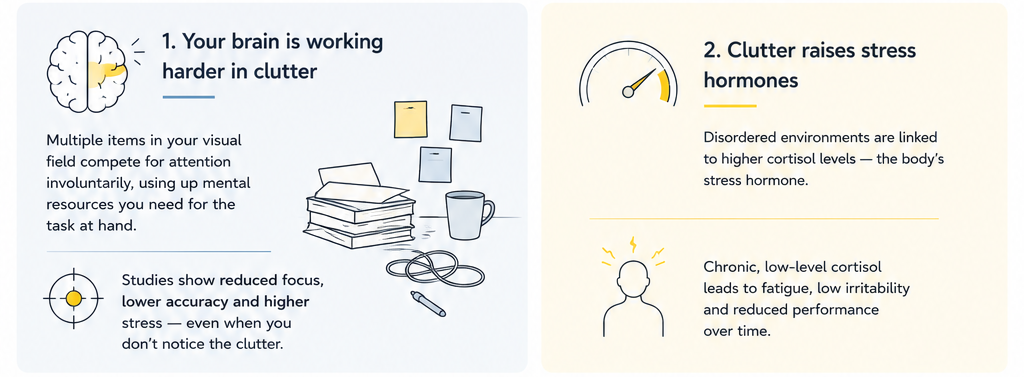
In 2011, researchers at the Princeton University Neuroscience Institute used functional MRI imaging to measure brain activity in participants working in both organised and cluttered environments. The findings were unambiguous: multiple stimuli in your visual field compete for neural resources simultaneously, and they do so involuntarily — you don't choose to process the pile of papers, the unwashed cup, the cable draped over the keyboard. Your visual cortex processes them anyway, allocating attentional capacity that would otherwise be available for the task in front of you.
The effect is measurable in task performance: participants in disordered environments showed consistently reduced ability to focus, lower information processing accuracy, and higher self-reported stress — even when they reported not noticing the clutter consciously. The unconscious processing is precisely the problem. You lose cognitive bandwidth to a tax you can't see being levied.
This matters most for the kind of work most WFH professionals are doing: writing, analysis, decision-making, anything requiring sustained concentration. The cognitive load from environmental noise has the same eroding effect as a poor night's sleep or low-grade background noise — except it's continuous, it's within your control, and most people aren't accounting for it at all.
The cortisol dimension
The attentional competition model explains the focus problem. There's a separate but related physiological mechanism behind the deeper fatigue.
Cluttered, disordered environments are consistently associated with elevated cortisol levels — a finding replicated across multiple studies, including the landmark 2010 UCLA study by Darby Saxbe and Rena Repetti that tracked cortisol patterns in dual-income households across three days. Participants whose homes were described in stressful terms showed flatter diurnal cortisol slopes — a profile associated not just with elevated stress but with adverse cardiovascular outcomes, impaired immune function, and disrupted sleep.
For someone working eight or more hours a day in their home office, this isn't a background detail. It's the biological environment in which their sustained performance is happening. The chronic low-level cortisol elevation of a disordered workspace isn't dramatic enough to feel like stress; it presents as something vaguer — low energy, mild irritability, the sense that today required more effort than it should have. That presentation is familiar to most people who work from home, and the environment is rarely identified as a contributor.
What "clean workspace" means — and what it doesn't
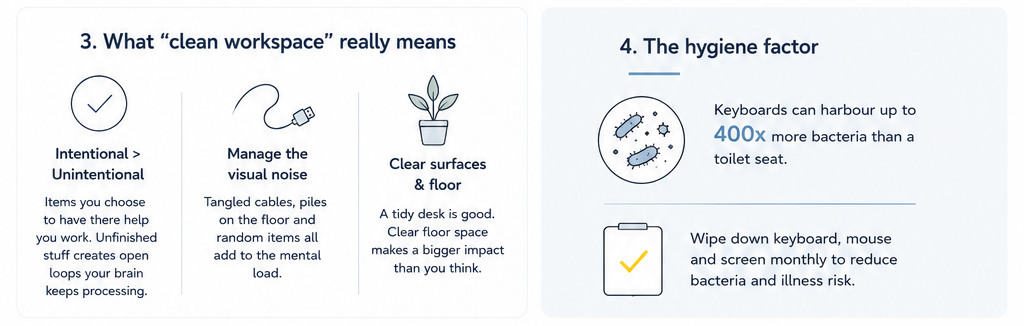
Clean workspace, in this context, isn't about minimalism. A bare desk with a single monitor and nothing else is not inherently better than a desk with some books, a plant, and personal objects — if those objects are there intentionally and arranged without chaos.
The research distinction is between intentional and unintentional presence of objects. Items you've chosen to have there because they help you work don't compete for attention in the same way that items you haven't moved yet do. The half-finished mug, the charger that belongs in a different room, the stack of letters you've been meaning to file — these register as open loops. Psychologist Barry Schwartz, writing on the paradox of choice, identifies unresolved environmental signals as a persistent source of low-grade anxiety: they represent things your brain is holding in partial attention, unresolved.
Cable management is worth naming specifically because it's underrated. The visual noise from tangled cables behind a desk is real and measurable — it's not aesthetic preference. Routing cables reduces the visual complexity that your visual cortex processes as irrelevant stimulation.
Floor space matters beyond the desk surface. Research on environmental perception consistently finds that floor clutter — boxes, bags, items that have landed but not been put away — changes how a space feels and performs cognitively, even when the working surface itself is clear.
The hygiene dimension nobody talks about
There's a separate argument for keeping a home office clean that doesn't touch cognition at all: it's genuinely one of the most contaminated environments in your home.
Keyboards harbour up to 400 times more bacteria than a toilet seat, according to research from the University of Arizona. The relevant strains include Staphylococcus aureus (linked to skin infections and, in resistant forms, MRSA) and various enteric bacteria — the consequence of desk-eating, infrequent hand washing, and the simple fact that keyboards trap organic matter in the gaps between keys where it accumulates and becomes a growth medium.
In open-plan offices, shared keyboards show even higher contamination rates. WFH removes the shared-keyboard problem but doesn't remove the underlying one: keyboards get cleaned when screens get cleaned, which for most people means almost never.
A monthly wipe-down of the keyboard (ideally with isopropyl alcohol, which evaporates without damaging electronics), monitor, and mouse is basic hygiene maintenance for an environment where you're spending more waking hours than any other.
The system that actually works
A clean home office isn't a one-off project — it's a set of habits at different time horizons:
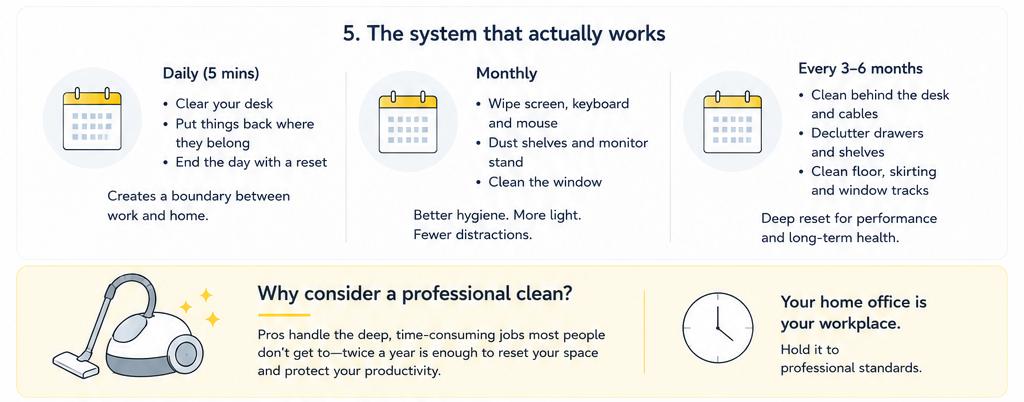
Daily (5 minutes at end of working day): clear everything from the desk that doesn't belong there. Establishing a defined end-of-day reset is also a psychological boundary signal — it separates work from home in a way the commute used to do. This isn't incidental to the cleaning habit; it's part of why the habit matters.
Monthly: wipe down the screen, keyboard, and mouse properly. Dust the monitor stand and surrounding shelves. Clean the window if it's in your sightline — a clean window doesn't just let in more light; it removes one more piece of visual information your brain is processing at the periphery of focus.
Every 3–6 months: address what accumulates invisibly — behind the desk (cable tangles, dust), inside drawers and on shelves (most things in a home office accumulate without serving an ongoing purpose), and the floor area around the desk. Dust around electronics is worth taking seriously: it impairs heat dissipation and shortens device lifespan, turning an aesthetic issue into an equipment maintenance one.
The case for professional help, specifically
A professional deep clean of a home office handles the things that fall outside a basic maintenance routine — corners, window tracks, the area behind equipment, skirting boards, the accumulated dust on shelves that never quite gets cleared in a quick tidy. Doing this properly twice a year costs far less in time and money than the compounding productivity loss from working in an environment that's quietly working against you.
If you work from home full-time, your home office is a professional environment. The standards applied to it should reflect that.
Sources: McMains & Kastner (2011), Journal of Neuroscience / Princeton Neuroscience Institute — visual competition and attention; Saxbe & Repetti (2010), Personality and Social Psychology Bulletin — clutter and cortisol; University of Arizona — keyboard bacterial contamination; Schwartz, B. — The Paradox of Choice (open loops and decision fatigue).
A thorough, dependable clean with a trusted pro — so your home is always ready when you need it to be. Book it weekly, fortnightly or monthly - and save 11% vs a one-off domestic clean.
Book a regular cleanBook a standard or deep clean, from 7am to 11pm, 7 days a week.
Book a home clean