

Why Cleaning Can Actually Be Therapeutic (And When It's OK to Hand It Over)
About this post
An exploration of why cleaning genuinely lifts mood—drawing on the psychology of task feedback loops, a Florida State study on mindful dishwashing, and the sense of control it offers during stressful periods. Also draws an honest line between cleaning as therapeutic ritual and cleaning as avoidance, and makes the case for when it's healthiest to just book a pro instead.
Posted by
Meg from UrbanTags
- Wellbeing
- City life
- Mental health
Book a treatment at home
Share
There's a reason "I cleaned the whole flat" is shorthand for a bad week. It's not just displacement — the connection between cleaning and psychological relief is documented, replicable, and runs through several distinct mechanisms. Understanding them makes the difference between using the habit well and not noticing when it stops serving you.
The study that proved it — properly
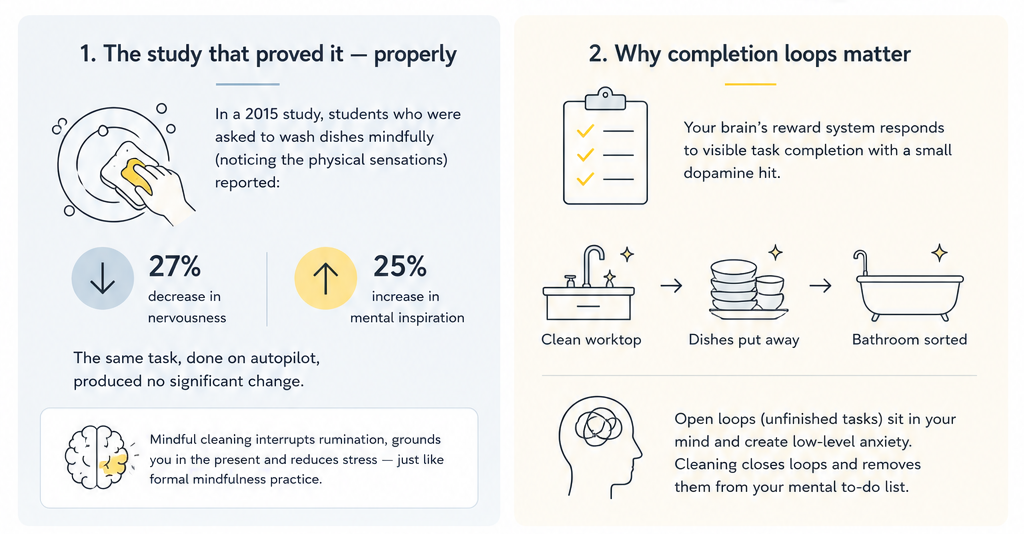
In 2015, researchers at Florida State University published a study in the journal Mindfulness that has since been widely cited but rarely read in full. Adam W. Hanley and colleagues recruited 51 students and assigned them either a mindful or a routine dishwashing condition. The mindful group was asked to read a brief passage encouraging them to attend to the sensory experience of the task: the warmth of the water, the smell of the soap, the feel of the dishes. The control group read a passage about effective dishwashing technique.
Both groups washed the same 18 dishes. Afterwards, the mindful group reported a 27% decrease in nervousness and a 25% increase in mental inspiration. The control group experienced no significant change in either measure.
The finding is more specific than it first appears. It wasn't the task that produced the effect — it was the manner of doing it. Cleaning done with sensory attention, as a present-moment experience rather than an obstacle to get through, generated measurable psychological benefit. The same task, done on autopilot while mentally elsewhere, did not.
This matters because it reframes what "cleaning as therapy" actually means. It's not that mopping the floor is inherently calming. It's that mopping the floor slowly, noticing the physical experience, is a form of informal mindfulness practice — and it works by the same mechanisms as formal mindfulness: it interrupts ruminative thinking, grounds attention in the present, and reduces activation of the default mode network (the part of the brain associated with mind-wandering and negative self-referential thought).
Why completion loops matter to a stressed brain
There's a second mechanism, distinct from mindfulness, that explains why cleaning relieves anxiety: the completion loop.
The brain's reward system — specifically the dopamine pathways running through the nucleus accumbens and prefrontal cortex — responds to task completion with a small release of dopamine. Not just to large goals, but to discrete, visible tasks: the worktop wiped, the dishes put away, the bathroom sorted. The feedback is immediate and unambiguous, in a way that most of what people do in knowledge work is not.
Writing a report doesn't feel finished until three rounds of revision. A project doesn't close cleanly. An email conversation continues. These are open loops — tasks that remain in the brain's working set without resolution. Research in psychology, particularly work building on the Zeigarnik effect (the finding that uncompleted tasks occupy more mental bandwidth than completed ones), suggests that accumulating open loops is cognitively and emotionally costly.
Cleaning closes loops. Not metaphorically — physically. The visual proof that the task is done (the clean kitchen, the clear desk) triggers the completion response and removes that item from your brain's running task list. For someone whose work life is largely composed of tasks without clear endpoints, the discrete visibility of a cleaned space is a meaningful psychological counterweight.
Psychologist Barry Schwartz, writing on the costs of too many choices and too many open decisions, makes the point that persistent low-grade environmental disorder — the things that need doing but haven't been done — is a continuous source of low-level anxiety, precisely because it populates your mental peripheral vision with unresolved tasks. Cleaning addresses this directly.
The physical rhythm as a calming mechanism
A third mechanism is the most straightforward: repetitive, low-stakes physical movement.
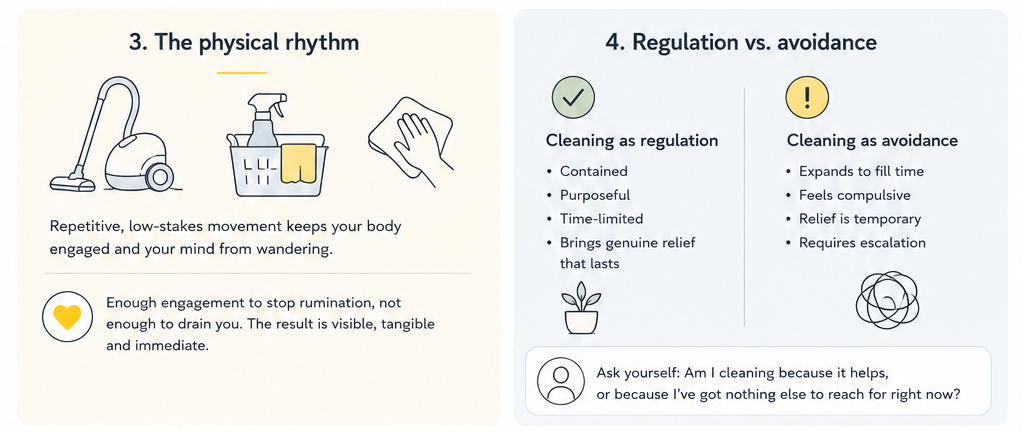
Vacuuming, scrubbing, wiping — these are activities that occupy the body and require just enough attention to prevent mind-wandering, but not enough to demand the kind of focused cognitive effort that depletes you. They sit in a particular zone of engagement that psychologists sometimes call "effortful automaticity" — you're doing something, which prevents the rumination of idleness, but you're not straining.
This is a profile that also describes certain forms of exercise, craft, and cooking, all of which have documented stress-reducing effects through similar mechanisms. Cleaning belongs in this category. The physical engagement is real, the mental demand is calibrated, and the result — visible, tangible, immediate — closes the loop.
The distinction that matters: regulation versus avoidance
All of the above is genuine. None of it means that cleaning is always or automatically therapeutic. There's a meaningful line between using cleaning as a tool for self-regulation and using it as a way to avoid something harder.
Cleaning as regulation: contained, purposeful, time-limited. You feel better when you're done and the feeling carries.
Cleaning as avoidance: it expands to fill available time, feels compulsive rather than chosen, and the relief is temporary and requires escalation. This pattern — cleaning that can't stop, that targets the same surfaces repeatedly, that's driven by anxiety rather than relieving it — is worth recognising because it's telling you something different. It's not the cleaning that needs addressing.
For most people, the question is simpler: are you cleaning because it genuinely helps, or because you've got nothing else to reach for right now? Both are understandable. But only one is therapeutic in any meaningful sense.
And when you genuinely don't want to
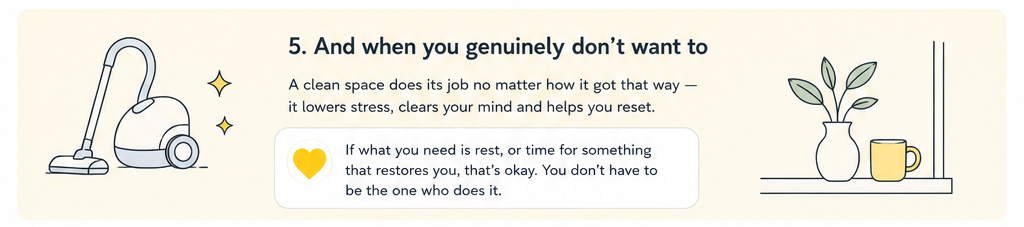
All of the psychological benefits above are real. None of them require you to be the one who does the cleaning. A clean space does its job regardless of how it got that way — the cortisol relief, the completion response, the visual calm. If what you actually need is to sit down, or to spend the afternoon doing something that restores rather than maintains, that's not an argument against clean spaces. It's an argument for someone else handling it this time.
Sources: Hanley, A.W. et al. (2015), "Washing Dishes to Wash the Dishes: Brief Instruction in an Informal Mindfulness Practice," Mindfulness journal, Florida State University; Zeigarnik, B. (1927) — incomplete tasks and memory (the Zeigarnik effect); Schwartz, B. — The Paradox of Choice; Saxbe & Repetti (2010), Personality and Social Psychology Bulletin — clutter, cortisol, and mood; Czeisler et al. — dopamine and task-completion reward pathways.
Discover the easy way to book cleaning services, as well as at-home clinic and spa treatments with the Urban app.
Book on-demand servicesBook a standard or deep clean, from 7am to 11pm, 7 days a week.
Book a home clean