

Why Cleaning Is One of the Most Common Things Couples Fight About

About this post
UK survey data on why cleaning causes more relationship friction than most couples expect—including the striking perception gap between partners on who does more—paired with Harvard research showing that outsourcing chores together, not dividing them differently, is the more reliable fix.
Posted by
Meg from UrbanTags
- Wellbeing
- City life
- Mental health
Book a treatment at home
Share
Ask most couples what they argue about, and money and in-laws usually top the list of expected answers. But according to UK survey data, household chores are close behind — and in the short term, they're often more frequent than either.
The scale of the disagreement
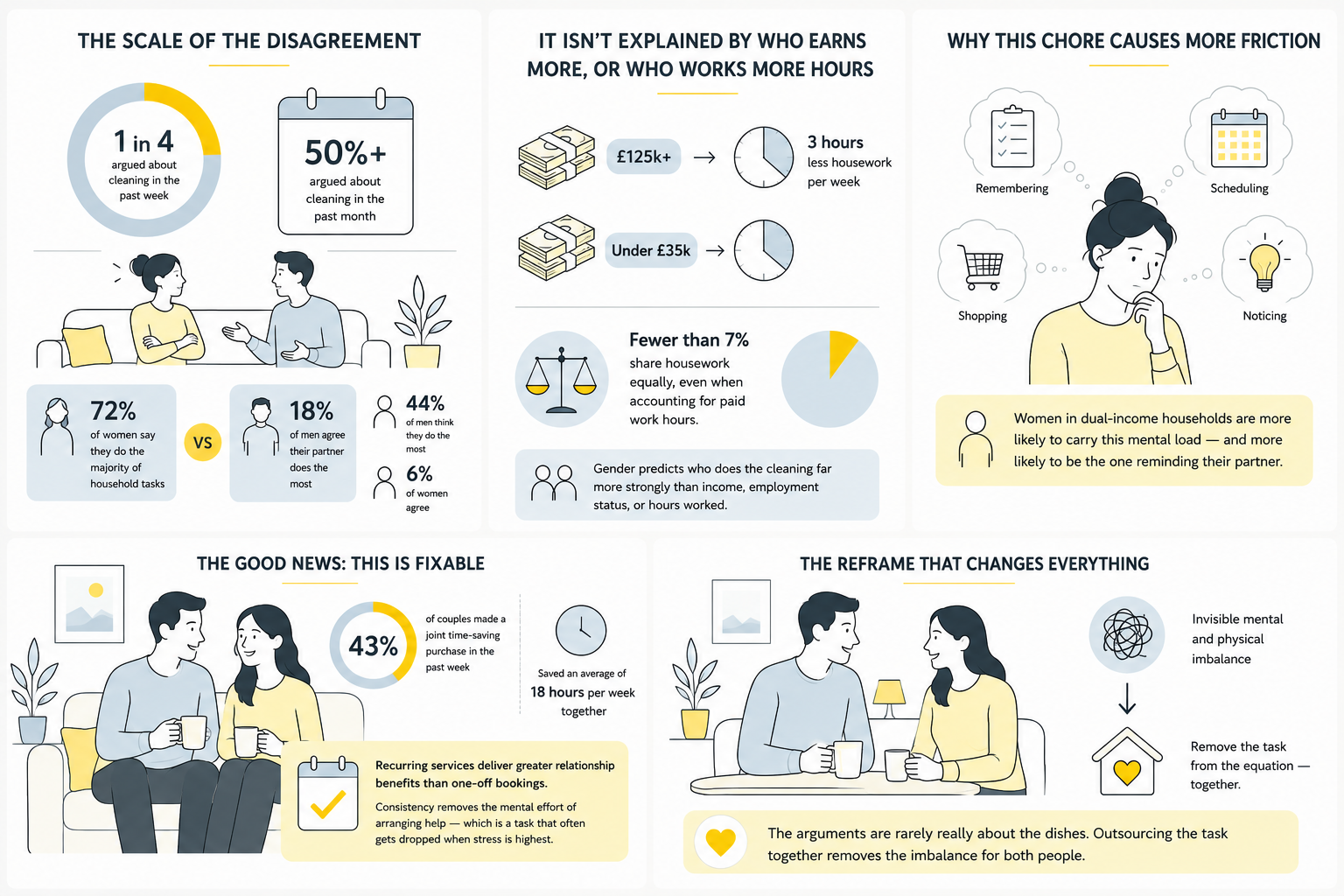
A 2023 Starling Bank survey of over 4,000 cohabiting UK couples found that more than a quarter had argued with their partner about cleaning duties within the past week, and over half had done so within the past month.
What's striking is how differently each partner sees the same division of labour: 72% of women said they did the majority of household tasks, while only 18% of men agreed their partner did the most. On the flip side, 44% of men believed they personally did the most at home — a view shared by just 6% of women. Two people, living in the same house, can genuinely disagree about who's doing more — and that perception gap is itself a source of friction.
The same survey found women in opposite-sex relationships reported an average of 36 hours a week on household tasks and "life admin" combined — equivalent to a full-time job — compared with 27 hours reported by men. That's a 9-hour weekly gap, more than a full working day.
It isn't explained by who earns more, or who works more hours
If you assumed this imbalance would even out once a woman becomes the higher earner, the data doesn't support that. The same research found that people earning above £125,000 a year did only three hours less housework per week than those earning under £35,000 — a small difference relative to the much larger 9-hour gap that exists by gender.
Separately, UCL researchers analysing over 8,500 UK couples found that fewer than 7% share housework equally, even accounting for differences in paid work hours between partners. Academic research on the division of household labour has similarly found that gender predicts who does the cleaning far more strongly than income, employment status, or hours worked outside the home.
Why this specific chore causes more friction than others
Household labour researchers distinguish between visible tasks (cooking, vacuuming) and less visible "life admin" — remembering what needs doing, scheduling it, noticing when something's run out. Research summarised by Berkeley's Greater Good Science Center has found that women in dual-income households are disproportionately responsible for this invisible coordination layer, on top of physical chores — and that they're also more likely to be the one reminding their partner to do a task, rather than the other way round. This dynamic, often called the "mental load," is frequently the actual source of resentment, even when the physical division of chores looks roughly balanced on paper.
The good news: this is one of the more fixable sources of relationship friction
This is where the research turns constructive. A Harvard Business School study led by Ashley Whillans found that couples who spent money to outsource unpleasant, recurring chores — cleaning chief among them — reported measurable improvements in relationship satisfaction. In one survey, 43% of couples had made a joint time-saving purchase in the previous week, saving an average of 18 hours between them. Notably, the research found it mattered less which partner ended up "using" the freed-up time, and mattered far more that the couple made the decision to outsource together, rather than one partner unilaterally hiring help.
Whillans' team also found that consistency compounds the benefit: couples who set up a recurring service, rather than booking help sporadically, got more relationship value out of it — largely because the mental effort of arranging help each time is itself a task that's easy to let slide during the exact stressful periods when it's needed most.
The reframe worth making
The data suggests the argument was rarely really about the dishes. It's about an invisible, ongoing imbalance in mental and physical labour that both partners often perceive completely differently — and one of the more reliably effective fixes isn't a better rota or a harder conversation. It's removing the task from the equation for both people, together.
Sources
Starling Bank (2023). Survey of 4,000+ UK cohabiting couples on household task division.
UCL Institute of Epidemiology and Health Care (2019). Analysis of 8,500 UK couples, UK Household Longitudinal Study.
Greater Good Science Center, UC Berkeley — research on unequal division of labour and relationship strain.
Whillans, A. et al. — Harvard Business School research on outsourcing chores and relationship satisfaction.
Discover the easy way to book cleaning services, as well as at-home clinic and spa treatments with the Urban app.
Book on-demand servicesBook a standard or deep clean, from 7am to 11pm, 7 days a week.
Book a home clean